The Irish Times' Inis Meáin Profile
50 Years of Aran Island Innovation
13th August 2026


We are delighted to have featured in the Irish Times Magazine last weekend, with an article dedicated to our 50th Anniversary beautifully written by The Irish Times Fashion Editor and long-time supporter of Inis Meáin, Deirdre McQuillan. The piece details our humble beginnings in 1976, a time where "there was no electricity nor running water, and goods were rowed in on the traditional currachs". The article also offers insight into the daily happenings at Cniotáil Inis Meáin, the official company name which is Irish for Inis Meáin Knitting Company, as well as telling the stories behind some of our most iconic designs, from signature Aran patterns to contemporary iterations of styles steeped in island heritage. Read full article below.

"Whatever you do, make it beautiful," counselled Áine de Blácam to her son Ruairí three years ago, when he and his wife Marie-Thérèse took over Inis Meáin Knitwear on the Aran Islands, which marks 50 years in business this year. Founded by Ruairí's parents Tarlach and Áine in 1976 to build a sustainable life on the wild island out in the Atlantic, that same imperative, along with the ability to draw from a rich heritage and a wide back catalogue, drives Ruairí's vision for the company.
Once described as the most remote knitwear brand in the world, it is the only knitting factory on the Aran Islands, established against formidable odds in the 1970s when emigration was high, where there was no electricity nor running water, and goods were rowed in on the traditional currachs. Today it is recognised internationally for the design and quality of its high-end knitwear, which is sold all over the world, its success attributed to the hard work and determination of its founders and the islanders.

Some of the pieces have become classics - like their innovative takes on the Aran sweater in supersoft wools highlighting the relief patterns. Others are inspired by pieces found on the island, or archival photos.
Their signature Máirtín Beag sweater, called after a local fisherman, is made from cashmere and merino wool, featuring intricate cables and a high neck, recently worn by Bradley Cooper. The Boat Builder Sweater is a popular version of the Aran fisherman sweater (worn by Grey's Anatomy actor Patrick Dempsey below), and the Pub Jacket is a relaxed style, with notched collar and three pockets in a wool-linen blend. The Raftery coat is another signature piece inspired by the 19th century nomadic Irish poet. Other celebrity fans include Cillian Murphy and Sonia O'Sullivan.

"Áine left her mark as a craftswoman on the styles and patterns of Inis Meáin knitting - she revived old patterns and old styles, and always insisted that they should be presented neatly and elegantly," Tarlach de Blácam said in the eulogy for his wife, who died in February.
He recalled their early days on the island, when they started adapting traditional designs to contemporary needs and fashion sensibilities. He looked at the complexities of the designs in both traditional workwear and the more ceremonial clothing worn for communions and confirmations, and brought those elements into the new knits to create pieces far removed from the usual sweaters sold to tourists.
"We had a clear vision of where we wanted to go and what we wanted to do - design and product development, something special and different and of the island and west of Ireland in terms of colour and style," he says when we meet at his home on the island, the firt two-storey house to be built there by the Congested Districts Board in the 1890s, originally for a teacher. "We never deviated from that idea of higher value and lower volume. Our best customers never asked the price - they just wanted something new and different."

The collections combined reimagined workwear and "Sunday best" like the pub jacket. This was originally drawn from a child's jacket that would have been in the repertoire of the local tailor at the time. It is seen in a famous portrait of islander Tom Cíaráin with his daughter Máirín and five other island children in traditional dress with pampooties, shawls and caipíní bobailín (bobble caps), taken on the island around 1920.
The clothes are testimony to the spinning, weaving, knitting and tailoring all done locally, and the photo has always had pride of place in Inis Meáin's communications, featuring in the brochure commemorating the 50th anniversary.

Tarlach's exhaustive and demanding travel every year to promote the knitwear and its authenticity over the decades once involved bringing a currach to Italy for the stand at the Pitti Immagine Uomo fashion week in Florence. There it remains.
With 40 pieces in each collection, the process of making the knitwear on state-of-the-art Shima Seiki machines is complex. There are 25 employees, many of them islanders, five of whom have worked in the factory for more than 30 years.

The luxury yarns from Biagioli Modesto in Florence cost between €100 and €200 a kilo, and one sweater alone can use up to six cones of wool. Setting up the machines and threading can take an hour. "There are so many steps in the making - getting the yarn right, the various tensions right, then the linking, then the washing stages and then the grading," explains Marie-Thérèse.
Already the couple are forging a new path for the company, driving online sales and using social media powerfully. "When we took over in January 2023, online sales were 12 per cent of total company sales; now they are over 50 per cent, and just over half of our production is to the US. The biggest challenge is living on an island, because of its geographical location and the impact of weather. But we are the only ones making on the Aran Islands, and that is a huge benefit."
Their bright and spacious store beside the factory sells an inviting selection of knitwear, scarves, ties and other items.
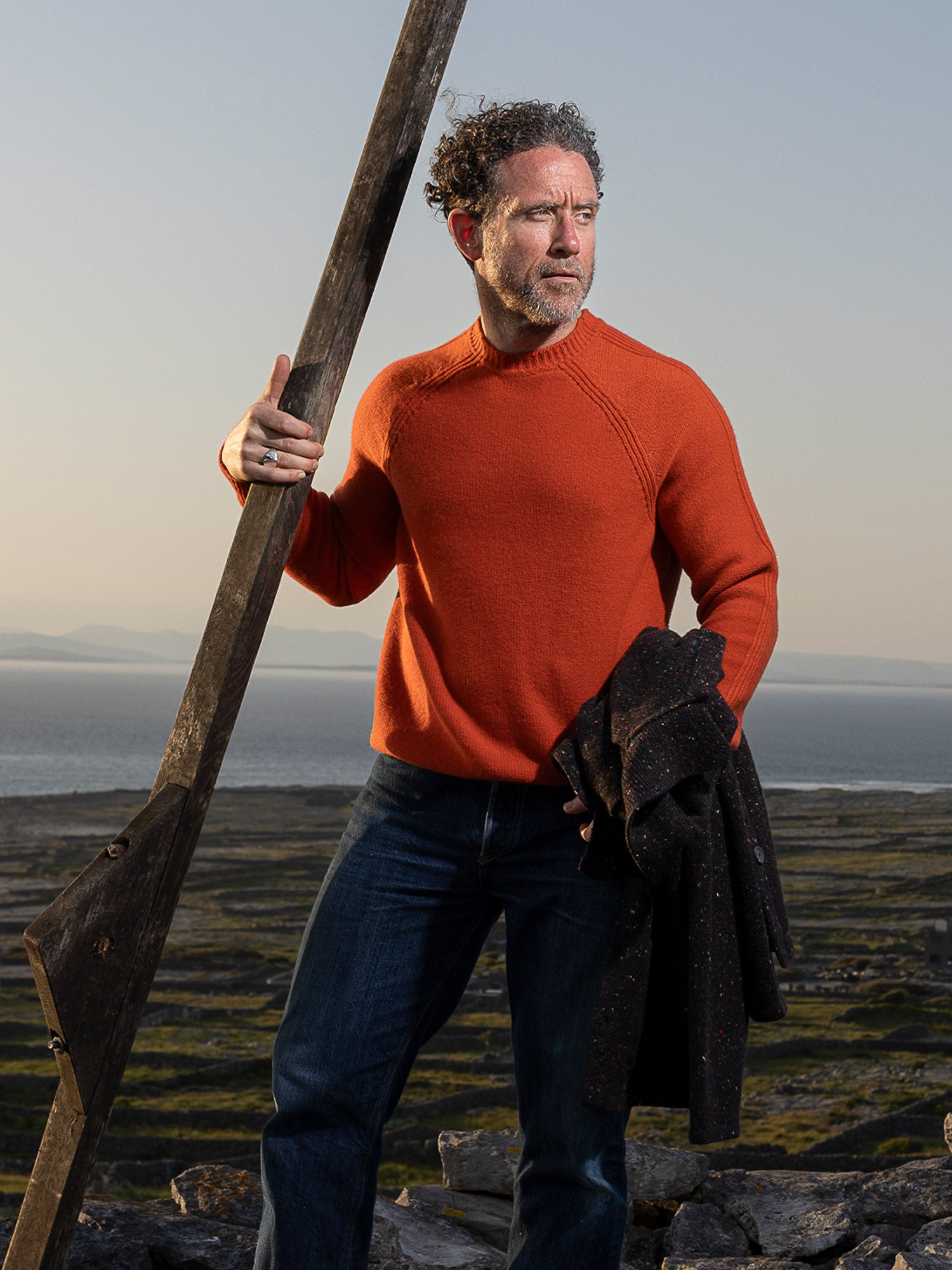
"We make micro batches of any given sweater in any given style or in any given colour, around 15 on average," Marie-Thérèse says. An Italian Zegna knit is more than twice the price of their sweaters, around €1,500, and would be manufactured in multiples. As knitwear specialists, they supply luxury style brand Mr. Porter and Todd Snyder, influential men's wear designer in New York, among others.
In July, in collaboration with Mr. Porter, Inis Meáin released a short film called "The Boy in the Gap" to celebrate the 50th anniversary of the company and the launch of the AW2026 collection, directed by Damian Foxe (former fashion director of the Financial Times HTSI magazine) with music by Martin Hayes. It knits together the landscape and island geography with the stitch patterns very creatively and beautifully, and is dedicated to Áine de Blácam.

For Ruairí, a trained chef who grew up with L'Uomo Vogue and National Geographic magazines and regularly accompanied his father on sales trips to trade shows in Paris and Florence, good design is in making.
"Be it in architecture, cooking or making cloth, the design is in the hand of the maker, and design is only as good as the maker. Every collection is like an iceberg, the final collection is only the tip of the iceberg. You leave absolute garbage behind before you know where you want to go."
The island itself is a constant source of inspiration, he says. "I was down at the pier last winter with my forklift getting deliveries of pallets of yarn. It was a still morning with the sun just coming up and you get it right between the eyes, the clouds are underlit and you have the blue, the bracken, the ferns, the grazing fields, the yellow, the whole spectrum is there in the winter light. So I panned with the camera and I thought - that's AW 2026 sorted, I've solved the colours," he smiles.

Architecture interests him; he refers to the Harry Clarke windows in the local church, and lines from Leonard Cohen's song Anthem: "There is a crack in everything, that's how the light gets in."
"Inspiration is around you all the time," he says.
He is currently prototyping several sweaters, hoodies and gilets for AW27, including an Aran with oversized blackberry motifs. As a retailer now, he says, "you are emboldened by the fact that you don't have to be as conservative as wholesale customers, so we can go nuts. I start with a bunch of mad ideas and then we start experimenting. As time goes on, we can get more emboldened, so it's a huge freedom. We were doing 15,000-16,000 units a year, and are now producing half that with the same turnover."
Plan also include adding a linen twill shirt, tweed trousers, a tweed jacket and a trench coat for winter. "So if someone wants to shop the whole look, they can do it."
With a rich catalogue from which to draw, whatever he designs or experiments with, he always refers to Tom Ciarain and that famous portrait of the islander with his daughter and local children pasted up on a noticeboard in his office. "Would Tom wear this? Your collections always must be anchored somewhere. He is my anchor."
Inis Meáin 50 - MADE IN ARAN SINCE 1976